Before the Genius: Bill Walsh’s Forgotten Start in the CoFL
How a short-lived minor league became the launchpad for football’s greatest innovator.
When football historians speak of Bill Walsh, the story usually begins in Palo Alto or San Francisco. The narrative traces his rise from Stanford to the San Francisco 49ers, where he became the architect of the West Coast Offense, a revolutionary system that reshaped the modern passing game.
But Walsh’s journey to Canton immortality began far from NFL glitz. In 1967, at a dusty outpost of professional football largely forgotten today, Walsh took his first steps as a head coach in the Continental Football League (CoFL).
The League Nobody Remembers — But Should
The CoFL was born in 1965 out of the ruins of the United and Atlantic Coast Football Leagues. Its founders envisioned a true “third league” — national in scope, professional in quality, and perhaps a rival to the NFL.
By 1967, it had expanded to the West Coast, with franchises in San Jose, Orange County, Seattle, Sacramento, and Victoria, British Columbia. It was “continental” in geography, if not in stability. Teams folded midseason, ownership groups defaulted, and crowds often numbered in the hundreds.
“The Continental Football League was less a rival than a proving ground — a hidden cradle of coaching and player talent.”
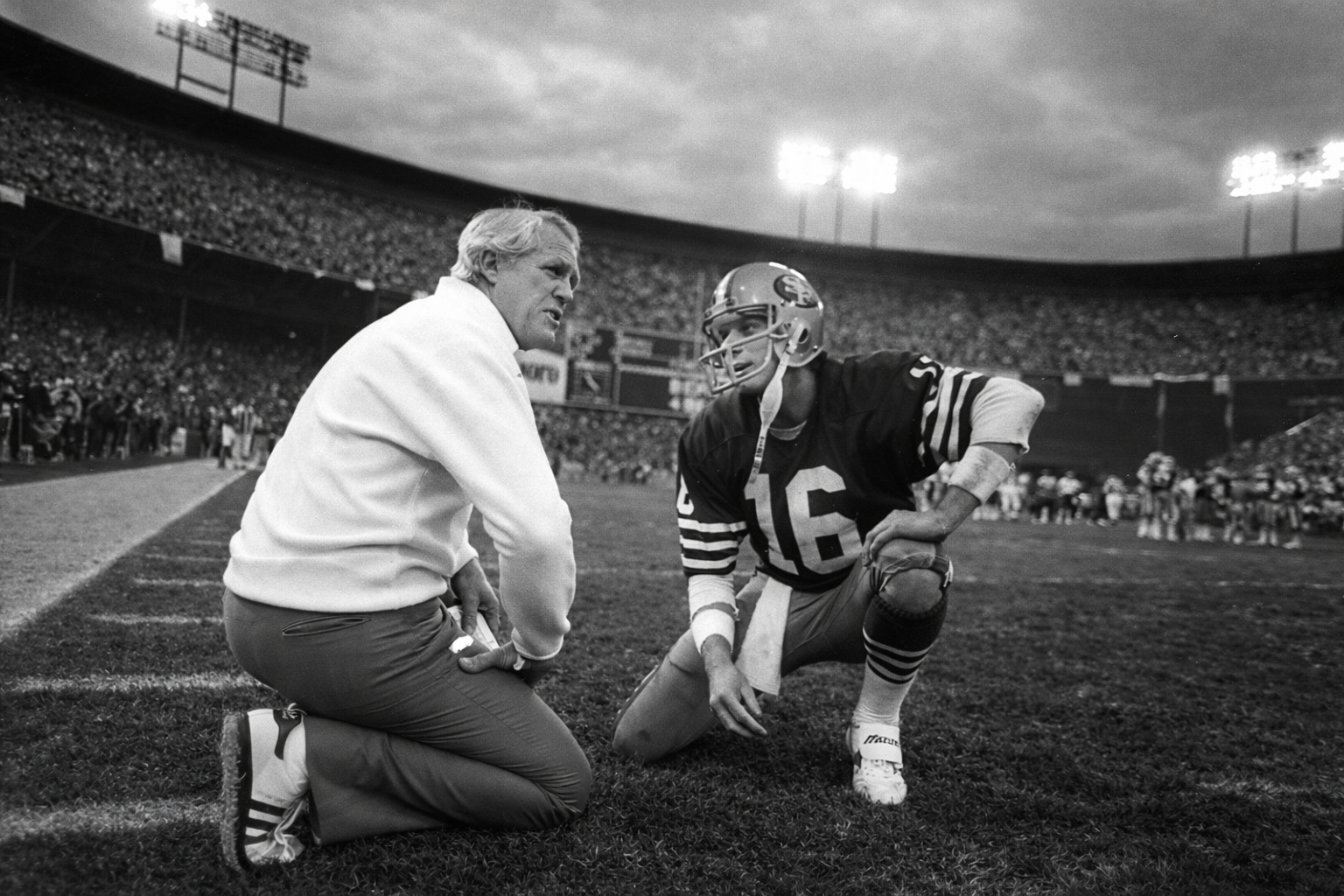
Coach Bill Walsh and Joe Montana
Enter Bill Walsh
By 1967, Walsh was a 35-year-old assistant bouncing between Stanford and Cal, known for his sharp mind but lacking the résumé of NFL playing experience that opened doors for most coaches.
The newly formed San Jose Apaches handed him the keys. For the first time in his career, he was a head coach. The position was hardly glamorous: the Apaches were underfunded, undermanned, and playing in Spartan Stadium before sparse crowds. But to Walsh, this was the opportunity of a lifetime.
Lessons in Adversity
The 1967 season tested Walsh daily. With rosters in flux and opponents with deeper pockets, the Apaches were overmatched. Instead of despairing, Walsh leaned on the tools that would define him later: precision, efficiency, and adaptability. Lacking superior athletes, he built schemes around timing and short passes. Lacking roster depth, he tailored plays to fit what his players could actually do.
“The genius of Bill Walsh wasn’t just his playbook — it was his ability to adapt the game to his people.”
The CoFL as a Hidden Laboratory
To outsiders, the CoFL looked like chaos. Teams folded. Paychecks bounced. Attendance sagged. But for coaches like Walsh, it was a laboratory. Payroll limits of $200 per week forced creativity. Unstable ownership demanded resilience. The absence of media glare allowed freedom to experiment.
“In the CoFL, football was stripped to its bones. For Bill Walsh, that was where genius took root.”
A League That Birthed Giants
Walsh wasn’t alone. The Continental Football League quietly nurtured a generation of football minds and future stars:
Sam Wyche — played and coached with the Wheeling Ironmen before leading the Cincinnati Bengals to a Super Bowl.
Andy Robustelli — Hall of Fame defensive end who cut his teeth coaching the Brooklyn Dodgers franchise.
Ken Stabler — quarterback for the Spokane Shockers before becoming the face of the Oakland Raiders.
Walsh’s Leap Forward
The San Jose Apaches folded after their lone season, but Walsh was forever changed. Soon after, Paul Brown hired him as an assistant with the Cincinnati Bengals, where Walsh refined the passing concepts that would evolve into the West Coast Offense. By the time Walsh took over the 49ers in 1979, he had a coaching philosophy forged in adversity. His San Jose experience taught him adaptability. His time under Brown taught him precision. Together, they made him the most influential football mind of his generation.
Please let me know the title you want me to reword.
Legacy of the Forgotten League
The CoFL folded in 1969, a casualty of poor finances and the NFL-AFL merger. In the grand story of football, it is usually treated as a footnote. But Walsh’s story reminds us: greatness often germinates in obscurity. Without San Jose and the CoFL, Walsh may never have gotten his first head coaching shot. Without those lessons, he may never have developed the adaptability that made him The Genius.
“Bill Walsh’s dynasty was born not in San Francisco, but in San Jose — in the forgotten Continental Football League.”