Otis Sistrunk: From the CoFL to the “University of Mars”
How a forgotten minor league launched a Raider legend
In the annals of pro football, some names stand out not only for their play but also for their legend. Otis Sistrunk is one of those names. Known as the big, bald defensive lineman of the Oakland Raiders’ 1970s glory years, Sistrunk became a cult hero — immortalized when ABC’s “Monday Night Football” jokingly introduced him as a graduate of the “University of Mars.”
But before he became a Raider icon, Sistrunk was just another overlooked player grinding in the shadows of the Continental Football League (CoFL). His time with the Norfolk Neptunes gave him the platform to showcase his raw power and toughness, and it served as the springboard to one of the most unusual — and inspiring — football journeys of the modern era.
The Forgotten League That Forged Legends
The CoFL, which existed from 1965 to 1969, was supposed to be a rival to the NFL and AFL. In reality, it was a shoestring operation, a patchwork of small-market teams playing in high school stadiums and municipal parks. Yet, the CoFL became a proving ground. It gave overlooked athletes — men who had been cut, undrafted, or ignored — a chance to keep playing. Some of those players, like Coy Bacon, Garo Yepremian, Ken Stabler, and Otis Sistrunk, used the opportunity to carve out paths to football immortality.
“The CoFL wasn’t glamorous. But for men like Otis Sistrunk, it was the only door still open.”
From Georgia Roots to Norfolk Neptunes
Otis Sistrunk was born in Columbus, Georgia, in 1946. Unlike many NFL players of his generation, he never played college football. After serving in the Marine Corps, he found himself chasing a dream that had no clear road map.
The Norfolk Neptunes of the CoFL gave him that shot. Norfolk was one of the league’s better-run franchises, attracting decent crowds at Foreman Field and building a reputation as one of the toughest teams in the circuit. For Sistrunk, the Neptunes became both a training ground and a launching pad.
Playing for Peanuts, Building a Reputation
The CoFL was notorious for its shoestring payrolls. By 1968, commissioner Danny Hill had capped salaries at $200 per player per week. Many players worked part-time jobs on the side to make ends meet. Sistrunk may not have been rich in cash, but he was building wealth in reputation. His size, raw power, and relentless motor stood out. Against players who had college pedigrees, he proved that toughness and determination could level the field.
“Otis Sistrunk never needed a degree to prove he belonged. The field was his classroom.”
The Leap to the NFL
By 1972, Sistrunk had fought his way into the NFL with the Oakland Raiders, a team that was a perfect cultural fit. The Raiders, under Al Davis, had a knack for finding overlooked talent and giving them second chances. Sistrunk was a natural Raider: hard-nosed, blue-collar, and intimidating.
He quickly became a fixture on the defensive line, starting in 96 games over seven seasons with the Raiders. He helped anchor a defense that reached the AFC Championship Game multiple times and culminated in a Super Bowl XI victory over the Minnesota Vikings in January 1977.
The “University of Mars” Moment
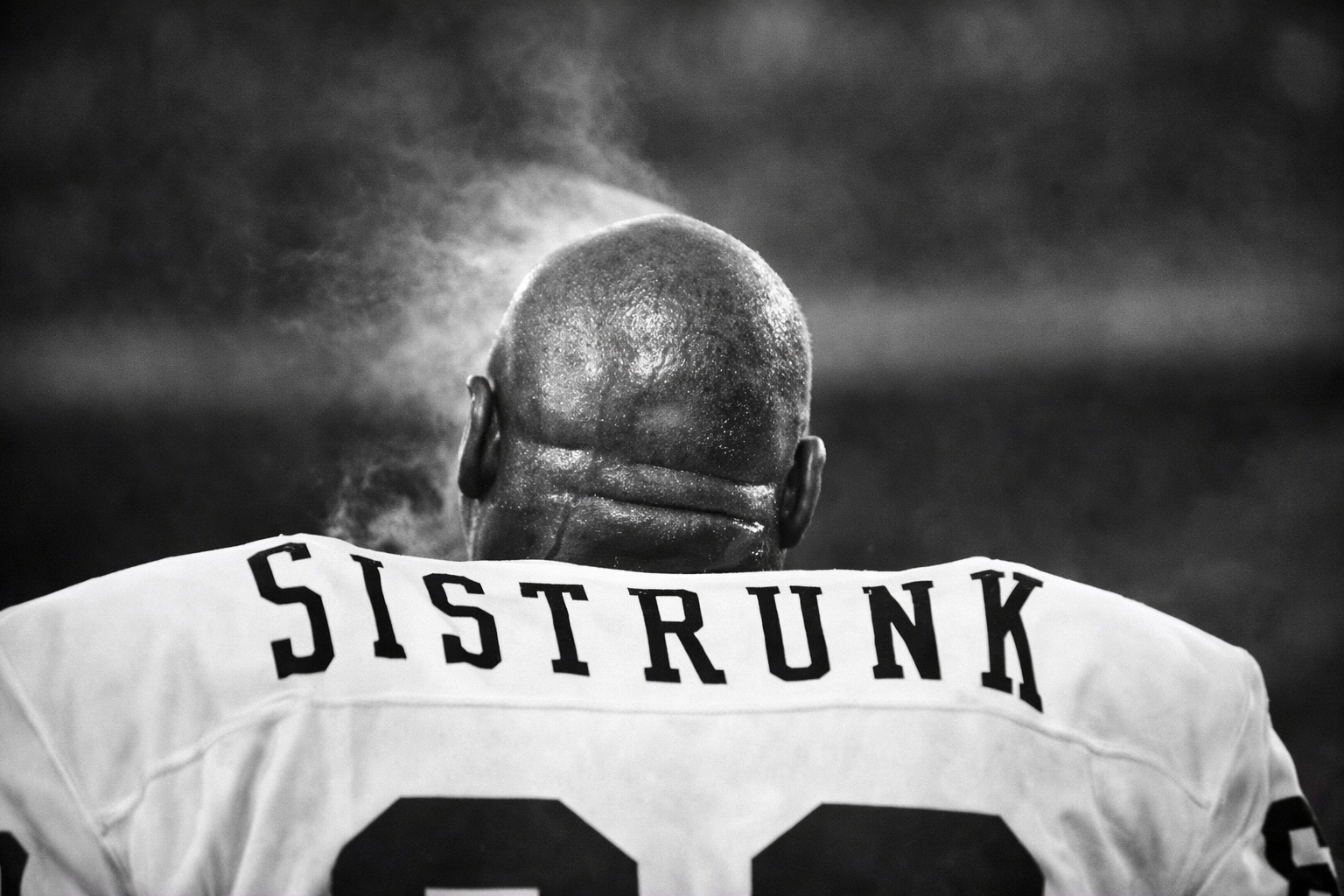
On October 22, 1972, during a Raiders game against the Houston Oilers, ABC’s Monday Night Football cameras panned the Oakland sideline. Broadcaster Alex Karras noticed Sistrunk’s bald head glistening under the stadium lights and quipped that he came from the “University of Mars.”
The line stuck. Fans loved it, media repeated it, and suddenly Sistrunk had one of the most famous introductions in NFL lore.
“Otis Sistrunk, Defensive Line, University of Mars.”
Raider Identity: A Perfect Match
The Oakland Raiders of the 1970s prided themselves on being misfits and castoffs, united under Al Davis’s mantra: “Just win, baby.” They thrived on players who had been told “no” elsewhere but proved indispensable in silver and black.
Sistrunk embodied that ethos. He wasn’t polished, he wasn’t pedigreed, but he was ferocious. In the trenches, he became a respected anchor, helping the Raiders bully opponents at the line of scrimmage.
“The Raiders didn’t care where you came from. If you could play, you belonged. That was Otis Sistrunk.”
A Cult Hero and a Lasting Legacy
Sistrunk retired from the NFL after the 1978 season, but his legend lived on. Raiders fans never forgot the bald-headed lineman from the “University of Mars.” His story remains one of the great reminders that the NFL’s doors are not always closed to unconventional paths. The CoFL, too, deserves a share of the credit. Without the Norfolk Neptunes, Sistrunk might never have had the chance to showcase his abilities. The league that folded in obscurity still managed to launch a player into the heart of one of football’s most iconic dynasties.
The Larger Lesson of the CoFL
Sistrunk’s story illustrates what the Continental Football League really was: not a rival to the NFL, but a hidden cradle of opportunity. For men without the right pedigree, without the right connections, or without the “right” résumé, the CoFL was a place to prove you could play. Just as it did for Bill Walsh, Sam Wyche, Ken Stabler, and Coy Bacon, the CoFL gave Sistrunk his shot. And he made the most of it.
Conclusion
Otis Sistrunk’s rise from the Norfolk Neptunes of the CoFL to Super Bowl champion with the Raiders is more than a quirky footnote. It’s a story of resilience, determination, and the power of second chances. The bald head, the “University of Mars” joke, the silver and black mystique — they’re all part of the legend. But at its core, Sistrunk’s journey is proof that greatness can come from the most unlikely places.
“The CoFL may be forgotten, but its players never will be. Otis Sistrunk is living proof.”