Nine Seconds
Before the game started, the Indianapolis Capitols' Black players stayed in the locker room during the National Anthem. When the anthem ended, they came out helmeted, arms taped from wrist to sleeve, and jogged to the sideline in the middle of a crowd that would rather not have counted them. The Capitols' roster in 1969 was, by the equipment manager's own recollection years later, roughly seventy percent Black. In the stands at Bush Stadium in Indianapolis, on a December Saturday in the closing month of the 1960s, the crowd could not tell.
That is where the story starts. Everything else — the miracle onside kick, the blocked field goal, the seventy-yard drive, the running back who ran into the end zone untouched with nine seconds left on the clock — happens against that backdrop.
It was December 13, 1969. Bush Stadium. The fifth and final Continental Football League Championship Game. Indianapolis Capitols against the San Antonio Toros. Eastern Conference against Western Conference. The Toros had just done something that should not have been possible. Down 38–28 with thirty seconds left, they had scored a touchdown, recovered an onside kick, and driven their kicker Jerry Moritz into position for a thirty-eight-yard field goal that he drilled with two seconds on the clock. The championship game had gone to sudden-death overtime.
Overtime opened. San Antonio drove. San Antonio missed the field goal that should have ended it. Indianapolis got the ball back at their own twenty. In eight plays, they went seventy yards. The quarterback found his receivers — Wynns, Winston, Moore — and the ball moved. Then, on second down inside the ten, fullback John Nice took a handoff, burst through a hole nobody laid a hand on, and scored the touchdown that won the last championship the original Continental Football League would ever play for.
Nine seconds left in overtime. 44–38, Indianapolis.
The quarterback who delivered the drive was a rookie who had not started a professional football game three months earlier, had signed his first professional contract for two hundred dollars at an awards banquet for Black colleges, and was, at the moment he threw the last completed pass of the last minute of the Continental Football League's five-year existence, the third Black quarterback in the modern history of professional football.
His name was Johnnie Walton. He was twenty-two years old. Nobody had been looking for him.
A Two-Hundred-Dollar Contract
Walton had spent four seasons quarterbacking at Elizabeth City State University, a historically Black school in northeastern North Carolina in the CIAA — the Central Intercollegiate Athletic Association, the oldest Black college athletic conference in the country. He was an all-conference selection. He had a live arm and a fast read. In 1969, the National Football League held its annual draft over seventeen rounds and four hundred forty-two selections. Johnnie Walton's name was not one of them.
The draft ended. The phone did not ring. So Walton went to a banquet in New York honoring the top Black college football players of the year, and at that banquet, he met a scout for the Los Angeles Rams. The scout liked what he saw. He offered a contract. The signing bonus was two hundred dollars.
Walton took it.
He reported to Rams camp in the spring of 1969 as an undrafted rookie free agent, in a quarterback room that already included Roman Gabriel — the reigning National Football League Most Valuable Player — and George Mira and Karl Sweetan. Walton played in several preseason games. His position coach, a young assistant named Dick Vermeil, took one look at his arm and told the head coach the kid could play. Roman Gabriel, years later, would put it this way: “I thought John was ahead of the game when he came to the Rams. I was impressed with his arm and he had a good feeling of where to go with the ball.”
None of that got Johnnie Walton on the fifty-three-man active roster. The Rams already had their quarterback. The Rams already had their backups. What the Rams had for Johnnie Walton was a spot on the taxi squad — the practice squad, in the language of a later era — and an allocation.
That is the word the National Football League used in 1969 for the arrangement that sent taxi-squad players out to minor-league professional teams for the fall so that their arms and legs stayed under game conditions until camp opened again the next spring. Walton was allocated. He was sent to the Indianapolis Capitols of the Continental Football League. He was, by contract, still property of the Los Angeles Rams. He was, by geography, playing home games at Bush Stadium on the West Side of Indianapolis. He was, by the calculation of professional football in 1969, a piece of equipment on loan.
He was also, on the day he reported to Indianapolis, the second-string quarterback behind a popular local Indiana University product named Frank Stavroff.
The Helmets Stay On
The Indianapolis Capitols played the 1969 season under head coach Ken Carpenter — a former first-round Cleveland Browns pick who had, three years earlier, taken the Charleston Rockets to the Continental Football League playoffs in the year after Perry Moss left for Orlando. Carpenter had a football team. He had an offensive line that could hold up. He had a defensive backfield with a rookie linebacker named John Nice who was going to matter later. And he had, at quarterback, one veteran and one rookie.
The veteran was Frank Stavroff. Stavroff had quarterbacked at Indiana University in Bloomington. He had gotten local press through the whole Capitols' 1968 season and into 1969. He was, in one contemporary account, “the Crown Prince” of Indianapolis quarterbacking.
When the Capitols opened the 1969 season on September 2, though, it was Walton who started — a 28–27 win over the Norfolk Neptunes. Then Stavroff took the job. The Capitols went along, five games in, doing what defending Eastern Conference contenders were supposed to do.
Then Stavroff got hurt.
Game six. Walton in. He would not leave.
The rookie who had signed for two hundred dollars won five of the next six starts. He threw fifteen touchdowns in that stretch. He introduced audibles to the Capitols' offense — his own signals, his own reads, at twenty-two years old, on a football team that had never used them. He led Indianapolis to a season-ending record of eight wins, four losses, and no ties in the Continental Football League's Eastern Conference — good for a division championship and a semifinal round bid.
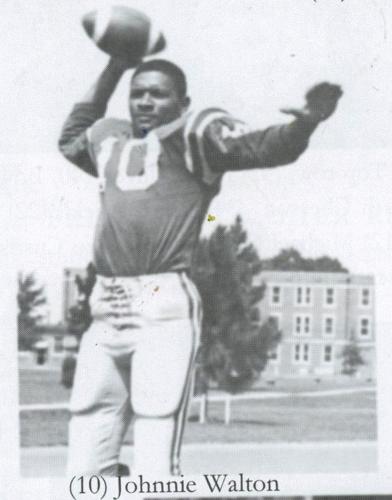
He was also, quietly, one of three Black men in America starting football games at quarterback for a professional football team that fall. Marlin Briscoe had broken in with the Denver Broncos of the American Football League the year before. James Harris had been drafted by the Buffalo Bills in the eighth round of the same 1969 draft that had passed Johnnie Walton over. Walton was the third. There were no others.
Which is where the anthem scene comes back in.
The Capitols' equipment manager was a Hoosier named Joe Wolfla. Half a century later, telling the story to the Indianapolis Star, Wolfla laid it out plainly: the Black players on the Capitols dressed in the locker room during the National Anthem. When the anthem ended, they came out already helmeted, and their arms were taped from cuff to sleeve so that skin would not show as they jogged to the sideline. The team was, in his recollection, seventy percent Black. The crowd, mostly white, did not count them.
Walton himself, years later, in an interview about his rookie season, did not soften his own read on why he had been on the Rams' taxi squad instead of on their roster: some coaches and owners, he said, “seem to think a Negro can't think.”
He was, in December of 1969, in the process of thinking his way to a championship.
Twenty-Seven to Seven
The 1969 Continental Football League Eastern Conference Championship was played on November 29 in Indianapolis. The opponent was the Orlando Panthers — the two-time defending Continental Football League champions, coached by Dick Pesonen, quarterbacked by Don Jonas, three-time league Most Valuable Player and the man who had turned down the Denver Broncos two years earlier to stay in the Continental Football League. It was, on paper, the game the Capitols were not supposed to win.
They won it 27–7.
Johnnie Walton, in his tenth start as a professional quarterback, walked out of the semifinal with a football team headed to Bush Stadium two weeks later and a full week of national football writers finally looking at the Continental Football League and asking who this kid was.
Don Jonas walked out of it with the third consecutive Panthers home playoff loss the once-dynastic Panthers had absorbed inside a stretch of two calendar years. The Orlando dynasty of the original Continental Football League was over. The rookie who had cost the Rams two hundred dollars was headed to the championship game.
Walton finished the regular season with 109 completions in 234 attempts, 1,713 yards passing, and seventeen touchdowns — fifteen of them in the final six games. He was named the Continental Football League's Most Valuable Player and named to the All-CFL team. Ken Carpenter was named the league's Coach of the Year. It was the second time in three years that a coach who had spent time on the Charleston Rockets' sideline had won a professional football coach-of-the-year award. Football is a small business. Everyone comes through everybody else's building sooner or later.
Two weeks later, San Antonio came to Indianapolis.
Sudden Death
The last championship game the original Continental Football League ever played was the game the Continental Football League had spent five years trying to have. Pro Football Weekly, writing about it later, called it “as major-league a football game as this minor league ever produced.” The scoring summary, sixty years later, still reads like a fever dream.
Indianapolis got on the board first. Gerry LaFountain, on the Capitols' punt team, came free off the edge in the first quarter, blocked a San Antonio punt, and the Capitols recovered inside the ten. A short drive later, Walton found Al Moore over the middle for a touchdown. 7–0.
Then LaFountain's blocked punt, converted into another Capitols touchdown, made it 14–0. Then, in a game that would eventually put eighty-two points on the scoreboard between the two teams, Walton and Moore hooked up again. Walton went for 217 passing yards on 14-of-30 accuracy. He threw two touchdown passes. He did not turn the ball over when it counted. The Toros' Ted Dean, a former Philadelphia Eagle, answered on the ground. Their quarterback Charley Johnson, a former Cardinal, kept them in it through the air. When the fourth quarter opened, the Capitols led by ten. When the fourth quarter's clock got inside two minutes, the Capitols led by ten. When the two-minute warning came and went, the Capitols led by ten.
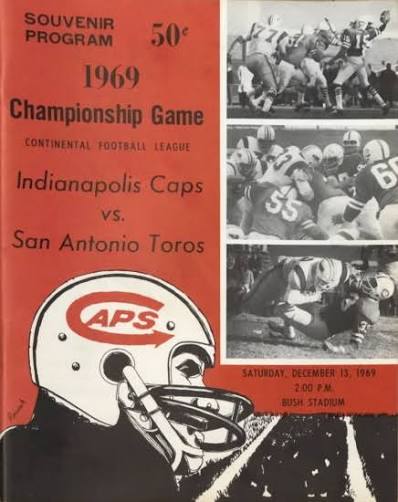
Thirty seconds left. 38–28, Indianapolis. That was the score with thirty seconds left in the last championship game the original Continental Football League would ever play.
Then Charley Johnson threw the touchdown that made it 38–35. Then Jerry Moritz recovered the onside kick that made it possible. Then Charley Johnson moved the football, and Moritz drilled a thirty-eight-yard field goal with two seconds left in regulation to make it 38–38 and force the extra period.
In overtime, San Antonio drove. San Antonio got inside the Indianapolis twenty. Moritz — the same Moritz who had just made the impossible one to force overtime — pulled the twenty-five-yard try wide. The ball came to Indianapolis at their own twenty.
Eight plays. Seventy yards. Walton to Wynns. Walton to Winston. Walton to Moore. A run. Another run. Then, second down inside the ten, John Nice with the handoff, and Nice through the hole nobody touched him in, and Nice in the end zone with nine seconds still showing on the Bush Stadium clock.
44–38.
“Johnnie Walton had just become the first Black quarterback in professional football history to win a championship.
The Quarterback Nobody Was Looking For
Johnnie Walton — the third Black quarterback in modern professional football, undrafted, signed off a banquet dinner, allocated to Indianapolis as a piece of taxi-squad equipment, given the football at halfway through the season and told to run the offense — had just become the first Black quarterback in professional football history to win a championship.
Nobody who had not been at Bush Stadium that afternoon knew it yet. Some of them, sixty years later, still do not.
After the Trophy
The Continental Football League folded three months later. Both teams that had played in the championship game — the Capitols and the Toros — withdrew from the league in the winter of 1970, and within weeks the whole thing was gone. Johnnie Walton went back to the Los Angeles Rams' taxi squad. And back the next year. And back the year after that. He would spend four consecutive seasons on the Rams' practice team — 1969 through 1972 — appearing in preseason games but never on a regular-season active roster. Dick Vermeil, his old position coach, would later say plainly that George Allen, the head coach, “liked experience.”
Walton left the Rams. He caught on in the World Football League with the San Antonio Wings and made All-Pro at quarterback there. When the WFL collapsed in 1975, he was without a team again. Then a familiar face came calling. Dick Vermeil had just been hired as the head coach of the Philadelphia Eagles.
“He called and flew me up to Philadelphia,” Walton said. “We talked and I signed with the Eagles as a backup.”
He signed in 1976. He would play four seasons in Philadelphia, from 1976 through 1979. When he took his first snap in an Eagles regular-season game, he became the first Black quarterback in the history of the Philadelphia Eagles franchise. He was thirty years old.
His statistical footprint in Philadelphia was small. That was not the point. The point was that a Black quarterback was on the field, in the huddle, in the game plan, in a National Football League city that had never had one before. That was a door that stayed open.
In 1983, at thirty-six years old, three seasons after he had left the Eagles and drifted into what he thought was retirement, Walton got another call. The United States Football League — the spring professional league that ran from 1983 through 1985 — had a franchise called the Boston Breakers, and the Breakers had a job. Walton took it. He was, in the first season of the USFL, the starting quarterback for a professional football team at thirty-six years old, fifteen years after the two-hundred-dollar contract with the Rams. Not a lot of quarterbacks come out of retirement to start in a professional league. Walton did. It was, by that point in his career, unsurprising to the people who had watched it.
The Return
When Johnnie Walton finally stopped chasing professional football snaps, he did the thing that so many of the best Black quarterbacks of his generation ended up doing when the doors closed one last time. He went back to the Historically Black school where he had started.
In 1981, before the Boston Breakers call ever came, Walton had returned to Elizabeth City State University as its head football coach. He coached the Vikings to what remains, four decades later, the school's last Central Intercollegiate Athletic Association football championship. He took them to the NCAA Division II playoffs. He coached at his alma mater on and off for the better part of a decade.
He is a member of the CIAA Hall of Fame. In 2023, he was inducted into the Black College Football Hall of Fame in Atlanta, alongside seven others in the same class, including former Eagles defensive coordinator Leslie Frazier. At the induction, he was seventy-six years old. He remains, at the time of this writing, still living, still lucid, still — if you catch him on the right afternoon — a man who will happily talk about the day John Nice ran through a hole nobody touched him in and won the last championship the original Continental Football League ever played for.
The Continental Football League returns in 2027. The new Indianapolis Capitols, under President and Managing Partner Lauren Boczek, are the second club in the history of professional football to carry that name. The first won the last title the original league ever awarded. The championship trophy from the December 13, 1969, sudden-death overtime win at Bush Stadium is the trophy the modern league carries forward. The Continental Cup was won, in the final moment of the original league's final chapter, by a rookie quarterback no one had drafted, signed for two hundred dollars, allocated to Indianapolis as an afterthought, and given the ball with a football team behind him.
That is what the new Capitols are inheriting. Not the building, which has changed. Not the roster, which has changed. Not the city around Bush Stadium, which has changed. The Cup. The story of who won it. And the quiet, historic act of quarterbacking that produced it, in a country that would rather not have noticed.
Johnnie Walton is the answer to a trivia question the trivia writers do not know how to ask. He is the first Black quarterback to win a professional football championship in North America. He won it in Indianapolis. He won it in overtime. He won it with nine seconds left. And he won it while the fans in the stands were still counting the men on his sideline wrong.
The nine seconds are the only part of that afternoon they got right.


